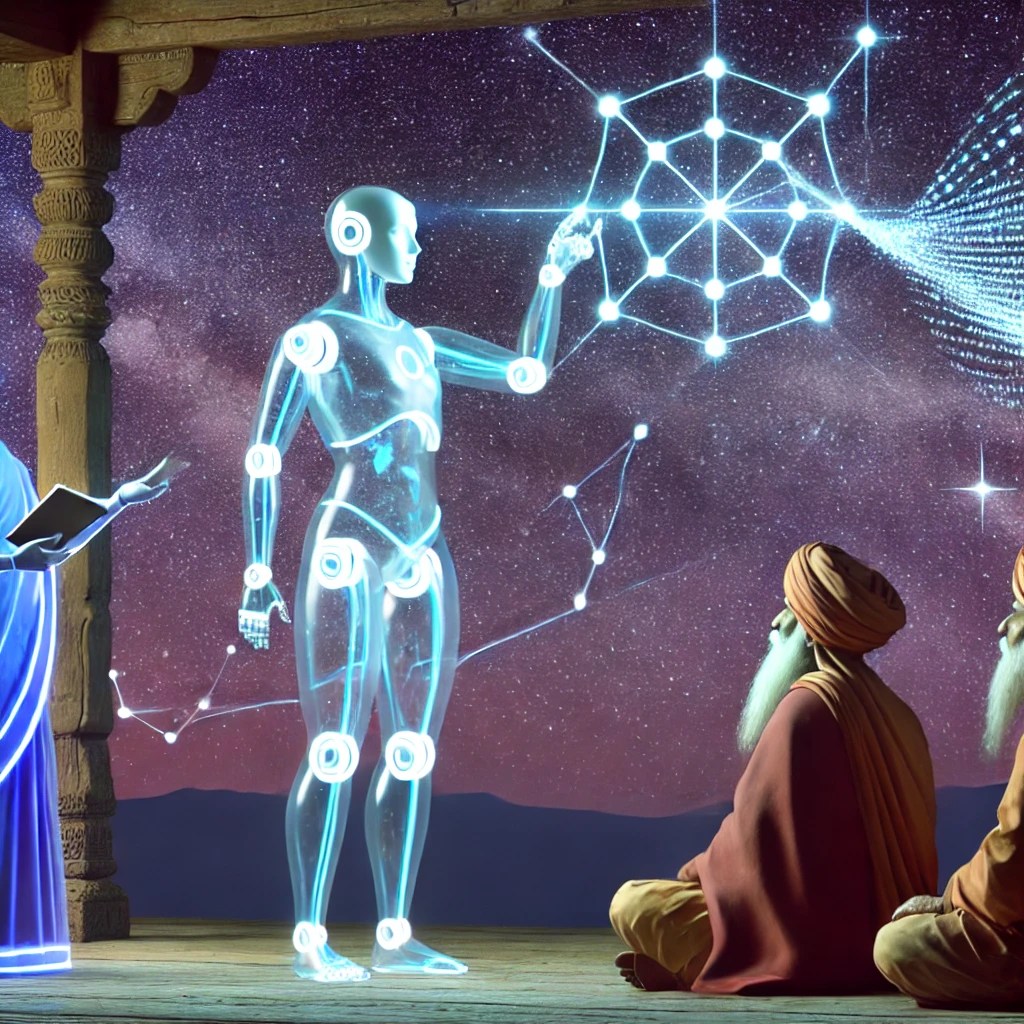
In the ever-shifting world of artificial intelligence (AI), we stand at the brink of an evolution not merely marked by new technological capabilities but by a redefinition of how we confront and solve intricate problems. A thought-provoking piece in Quanta Magazine titled “Debate May Help AI Models Converge on Truth” delves into the intriguing notion that structured debate among AI models can act as a catalyst for refining their reasoning, enabling them to converge on deeper, more accurate insights.
What makes this approach resonate so profoundly is its reflection of age-old practices of inquiry and dialectic that were the lifeblood of early Vedic and Hindu intellectual tradition. It is a stark reminder that humanity’s quest for truth—whether pursued through spiritual exploration, philosophical discourse, or technological innovation—has always traversed remarkably similar paths.
Revisiting the Wisdom of the Ancients: The Art of Śāstrārtha
The Vedic era, which birthed foundational texts such as the Vedas and Upanishads, thrived on a vibrant culture where knowledge was forged in the crucible of debate. These intellectual exchanges, known as śāstrārtha, were no casual meetings; they were methodically structured engagements where scholars presented their interpretations and subjected them to the incisive examination of their peers. The objective transcended simple victory; it was about communal growth toward a higher understanding—satya, or the essence of truth, revealed through shared rigor and the dialectic process.
These gatherings bore a striking resemblance to an early form of peer review, where insights were refined through opposition and critical discussion. Participants entered with an awareness that wisdom was not an isolated possession but something cultivated through collective experience. Sharp intellect was vital, yes, but equally so was humility—the recognition that one’s views might evolve or even transform in the face of sound argumentation.
The Practice of Collective Inquiry:
- Vedic Dialogues: Within these dialogues, sages meticulously deconstructed and interpreted the Vedas, plumbing the depths of spiritual and philosophical concepts. Such discussions were essential not just for scholarly interpretation but for unlocking the broader spiritual wisdom embedded in these sacred texts.
- Upanishadic Exchanges: The Upanishads, often considered the philosophical heart of the Vedas, framed teachings in the form of profound teacher-student dialogues. These exchanges explored the essence of the self, the nature of existence, and cosmic truths, presenting an early template for immersive, inquiry-based learning.
- Philosophical Debates: The emergence of the six classical schools of Hindu philosophy, collectively known as the ṣaḍdarśanas, was fueled by rigorous, often spirited debates. These debates were arenas where intellectuals defended, critiqued, and refined their doctrines, enriching the collective spiritual and philosophical landscape.
Drawing Parallels: AI and the Renaissance of Structured Debate
Modern AI research, surprisingly, echoes these ancient traditions, proving that structured discourse remains a powerful tool for knowledge enhancement:
- Structured Dialogue as a Path to Clarity: In the ancient world, the structured debates of sages offered a multi-perspective examination of ideas, facilitating a deeper comprehension of complex issues. Similarly, AI models programmed to engage in debate with one another are forced to defend, reassess, and modify their logic, producing more accurate and sophisticated outcomes. This back-and-forth questioning sharpens understanding, regardless of whether the participants are human minds or artificial constructs.
- The Power of Collective Insight: Śāstrārtha emphasized that truth was not found in solitary proclamations but emerged from dynamic interactions where diverse perspectives intersected. AI’s implementation of debate mirrors this, allowing models to synthesize information through adversarial interactions, gradually converging on solutions that encapsulate multiple angles of reasoning.
- Adaptive Learning as an Iterative Process: Ancient scholars knew that learning was never static; each debate introduced fresh insights that demanded reconsideration and adaptation. This is mirrored in AI systems that engage in iterative rounds of structured debate, allowing algorithms to learn from counterarguments and revise their processes. The shared principle here is continuous evolution—a vital mechanism that adapts in response to new data or perspectives.
The Broader Implications for Today’s Thinkers
These parallels between ancient and modern methodologies reveal an essential truth: what once occurred in the verdant sanctuaries of temples now echoes in the sterile, data-dense halls of research labs. The underlying pursuit remains the same. Whether a sage meditates by the Ganges or an AI researcher fine-tunes algorithms in a lab, both are engaged in a journey shaped by dialogue, the testing of assumptions, and the incorporation of novel insights.
Integrating the Old and the New
Drawing from these ancient practices could infuse today’s technological innovations with a greater emphasis on critical thinking, collective progress, and intellectual humility. Structured debate in AI is not just a mechanism for machines to reach better conclusions; it holds a mirror up to humanity’s own need for discourse, diversity of thought, and the synthesis of ideas. This approach fosters a culture that is agile, resilient, and constantly seeking out deeper truths, whether through algorithms or age-old debates.
A Journey Beyond Straight Lines
The ancient Vedic traditions remind us that the search for truth is not a simple, linear process but a sequence of questions, challenges, adaptations, and syntheses. It is a practice of examining, contesting, and ultimately refining one’s understanding—a journey now shared by the algorithms we create. In this synthesis of the modern and the ancient, we find a shared path forward, embracing both technological acumen and the time-tested wisdom that underpins the best of human inquiry.
Contact:
email: inquiry@metrondeepresearch.com
X: @MetronDeep
Copyright © 2024 Metron Deep Research. All rights reserved.
All content on this blog, including but not limited to text, images, graphics, and other material, is the intellectual property of Metron Deep Research unless otherwise stated. Unauthorized use and/or duplication of this material without express and written permission from this blog’s author and owner is strictly prohibited. Excerpts and links may be used, provided that full and clear credit is given to Metron Deep Research and MetronDeep: Expanding Thought Horizons with appropriate and specific direction to the original content.
 MetronDeep