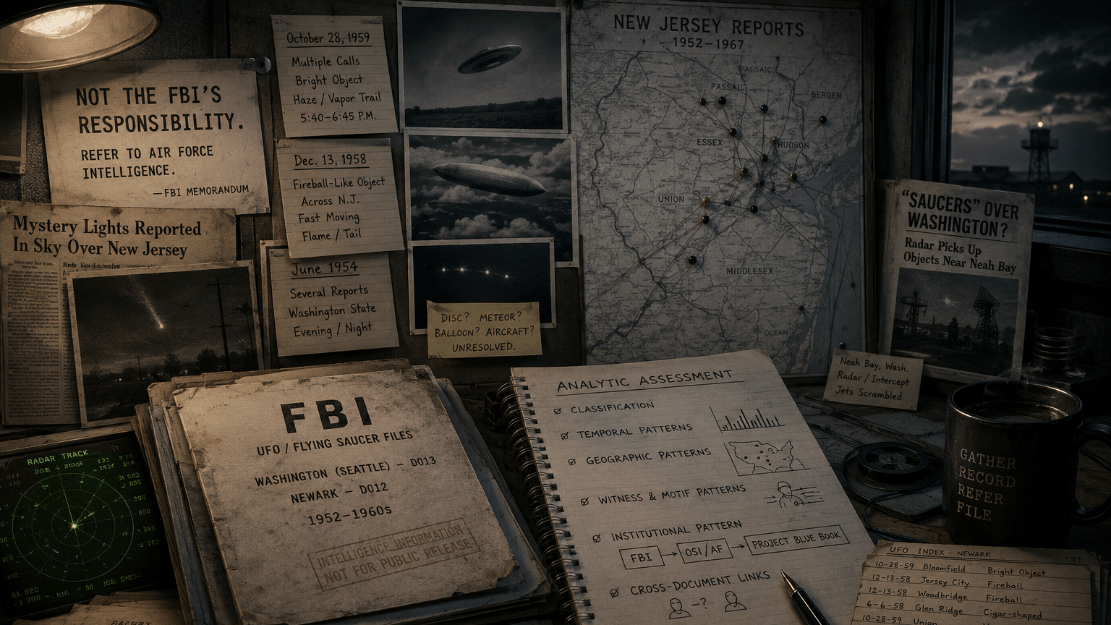
The third tranche of UAP files from the Department of War was recently published. Of the talk amongst researchers, it’s apparent that some of the most interesting files are from the FBI circa 1952 – 1967 from two different field offices. We took those 2 files as the source material for our most recent analysis.
File names are: FBI-UAP-D012-Newark Field Office and FBI-UAP-D013 WA-UFO-Investigation
The PDF files consisted of some poorly readable OCR, but for the most part, this did not hinder the analysis, and the portions that were degraded were easily identified and accordingly factored into a confidence key applied to sighting classifications.
Confidence key:
High = core date/location/object description clear.
Medium = usable but incomplete.
Low = OCR/redaction or sparse report prevents firm classification.
For each classification, we apply to our matrix the Hynek Category system, e.g. [Nocturnal Light, Daylight Disc, Radar-Visual, CE-I/II/III], among other vectors that will be obvious to the reader.
Analytic assessment of the cataloged FBI UFO/UAP files
Scope: FBI-UAP-D013 Washington/Seattle file, 1952–1960; FBI-UAP-D012 Newark file, 1952–1967. This assessment uses only the cataloged records from the attached files, with outside context used only for Project Blue Book/Sputnik framing. The FBI file evidence shows that the Bureau mainly recorded, indexed, and referred UFO reports rather than substantively investigating them as FBI matters. The Air Force’s Project Blue Book, headquartered at Wright-Patterson AFB, was the formal USAF UFO-investigation program from 1947–1969.
1. Classification by sighting
Confidence key:
High = core date/location/object description clear.
Medium = usable but incomplete.
Low = OCR/redaction or sparse report prevents firm classification.
| ID | Morphology | Hynek category | IFO/UFO triage | Confidence |
| WA-001 | star-like light | Nocturnal Light | possible meteor/bolide; unresolved due sparse data | Low |
| WA-002 | other | Daylight Disc / daylight object | possible balloon/parachute-like object | Medium |
| WA-003 | star-like light / other | Daylight Disc / daylight object | possible balloon/aircraft reflection; unresolved | Low-Medium |
| WA-004 | disc | Daylight Disc | genuinely unresolved on available data; witness considered radar-target balloon, but motion claim conflicts with simple balloon | Medium |
| WA-005 | multi-light / other | Nocturnal Light | possible meteor/bolide cluster; unresolved | Low |
| WA-006 | other | Nocturnal Light | unresolved; core fields unclear | Low |
| WA-007 | other | Daylight Disc | possible high-altitude aircraft/balloon; unresolved | Medium-Low |
| WA-008 | multi-light formation | Nocturnal Light | possible aircraft/flares/atmospheric effect; unresolved | Medium |
| WA-009 | other | Nocturnal Light | unresolved; newspaper-derived and sparse | Low |
| WA-010 | other / radar target | Radar-Visual, but visual portion negative or uncertain | likely aircraft/radar targets per Air Force-style language; unresolved only if radar data accepted as anomalous | Medium |
| WA-011 | star-like light | Nocturnal Light | possible aircraft/satellite/meteor; unresolved | Low |
| WA-012 | other | CE-I, if low-altitude stop-and-hover claim accepted | genuinely unresolved on available data; report is retrospective | Low-Medium |
| WA-013 | other | Daylight Disc / Nocturnal Light unclear | unresolved | Low |
| WA-014 | other | CE-I / other | possible balloon/kite/beach object; unresolved | Low |
| WA-015 | star-like light / other | Nocturnal Light | possible meteor/bolide; unresolved | Low |
| NJ-001 | disc | Daylight Disc | genuinely unresolved on available data; photographic authenticity not established | Medium |
| NJ-002 | cylindrical/cigar | Daylight Disc | possible aircraft/dirigible/rocket-like aircraft; unresolved | Medium |
| NJ-003 | bullet / other | Nocturnal Light | genuinely unresolved on available data; trained observer but no corroboration | Medium |
| NJ-004 | multi-light formation / other | Nocturnal Light | possible aircraft lights/ad/searchlight; unresolved | Low-Medium |
| NJ-005 | cylindrical/cigar | Daylight Disc | possible aircraft; unresolved | Medium |
| NJ-006 | bullet | Daylight Disc | probable aircraft/jet at altitude with vapor trail | Medium-High |
| NJ-007 | other | Daylight Disc / Nocturnal Light unclear | probable meteor/bolide or re-entry | Medium |
| NJ-008 | other | Nocturnal Light | probable meteor/bolide or re-entry | Medium |
| NJ-009 | other | Nocturnal Light | probable meteor/bolide or re-entry | Medium |
| NJ-010 | star-like light | Nocturnal Light | probable meteor/bolide or re-entry | Medium |
| NJ-011 | other | Nocturnal Light | possible aircraft; unresolved | Low-Medium |
| NJ-012 | other | Nocturnal Light | unresolved; “silver object” too sparse | Low |
| NJ-013 | multi-light formation | Nocturnal Light | possible satellites/aircraft; Sputnik-era “satellite speed” comparison is notable | Medium |
| NJ-014 | other | Nocturnal Light | unresolved; witness could not establish distance/altitude | Low |
| NJ-015 | star-like light / other | Nocturnal Light | possible missile/rocket event, re-entry, aircraft condensation/vapor trail; unresolved | Medium |
| NJ-016 | other | Nocturnal Light | possible aircraft/jet event, flare, rocket/re-entry; unresolved | Medium |
| NJ-017 | other | Nocturnal Light | unresolved; details withheld for OSI follow-up | Low |
| NJ-018 | star-like light / multi-light | Nocturnal Light | possible Venus/bright planets or stars; weather balloon also raised by witness | Medium |
| NJ-019 | other | Other / insufficient | not enough specific sighting data | Low |
| NJ-020 | other | Nocturnal Light | unresolved; recurring claimant, sparse detail | Low |
| NJ-021 | multi-light formation | Nocturnal Light | possible aircraft/aircraft lights; unresolved | Medium |
Classification finding: Most cataloged entries fall into Nocturnal Light or Daylight Disc/daylight object categories. Only one case has a meaningful radar component, WA-010, and even there, the file records radar/air-intercept activity rather than a confirmed visual object by pilots. The strongest “classic UFO” morphology cases are NJ-001 Passaic photographs, WA-004 Richland/Hanford disc-like observation, NJ-002 Glen Ridge cylindrical object, and NJ-003 Clifton “underwater demolition bomb” report. The Air Force requested background/reliability checks in the Passaic photo case, not an FBI determination that the object was authentic.
2. Temporal patterns
Distribution by year, from the catalog
1952 | ██ 2
1953 | ████ 4
1954 | █████ 5
1957 | ████ 4
1958 | █████ 5
1959 | ██████ 6
1960 | ███ 3
1961 | ██ 2
1963 | █ 1
1966 | █ 1
Unknown/uncertain | ███ 3
The main concentration is not a single sustained wave but several clusters: Washington reports around 1953–1954, Newark/New Jersey reports around 1957–1960, and a smaller, later tail in 1961–1966. The 1957 Newark cluster is plausibly connected to the broader post-Sputnik and late-1950s UFO-reporting environment, but the file itself does not prove causation. Sputnik 1 launched on October 4, 1957, marking the start of the Space Age, and Project Blue Book was active during this period, giving the public a named Air Force reporting channel.
Distribution by month, from known dates
January | ██
February | █████
March | █
April | ██
May | █
June | █████
July | ███
August | ██
October | ███
November | ████
December | ███
Unknown | multiple degraded records
The month pattern is uneven but not conclusive. June 1954 in Washington and late 1957 through early 1960 in New Jersey are the strongest clusters.
Time-of-day pattern
The catalog shows a dusk/evening/night skew, especially in the Newark file. New Jersey entries repeatedly occur around 5:40–7:15 PM, 8:30 PM, 10:00–10:35 PM, and after midnight. The FBI memo for October 28, 1959, for example, records several calls between 5:40 and 6:45 PM describing a bright object with twinkling lights, haze, and vapor trail.
Inference, medium confidence: The dusk/evening skew likely reflects visibility conditions and human availability: bright planets, aircraft lights, satellites, vapor trails, and re-entry/meteor events are more noticeable at twilight and night. The file supports the skew; it does not by itself prove the cause.
3. Geographic patterns
New Jersey concentration
The Newark file reports are concentrated in northern and central New Jersey, especially:
| County / area | Towns or locations appearing in catalog | Pattern |
| Essex County | Glen Ridge, Bloomfield, West Orange, East Orange, Upper Montclair | strongest hotspot |
| Passaic County | Passaic, Clifton, West Paterson | early photo case and later reports |
| Union County | Union, Fanwood, Springfield | several 1958–1960 reports |
| Hudson County | Jersey City, Kearny | nocturnal light/fireball reports |
| Middlesex County | Perth Amboy area, Woodbridge, Old Bridge/Cliffwood, Sewaren | several moving-light/fireball reports |
| Bergen County | Lodi, Palisades Park | later and lower-detail reports |
| Ocean / shore area | Surf City; Route 35 shore-to-Perth Amboy travel | part of statewide bright-object cluster |
Geographic finding, medium confidence: Newark-area suburban and urban corridors dominate the file because this is the Newark field-office file, not because UFO events objectively concentrated there statewide. Still, within the file, Essex County is the clearest reporting hotspot.
Proximity to airfields/installations
The files repeatedly reference military or aviation infrastructure: Sand Point Naval Air Station in Seattle, McChord Field/AFB and OSI in Washington, Neah Bay radar/intercept activity, Camp Kilmer OSI in New Jersey, and Wright-Patterson/ATIC/Project Blue Book channels. The Washington file explicitly includes a Bureau notice stating that the Air Force, not the FBI, had responsibility for investigating flying discs, and that reports should be sent immediately to local Air Force intelligence.
Inference, high confidence: Reports near air stations and radar sites were more likely to be referred into military-intelligence channels.
Inference, medium confidence: Some sightings may have been ordinary air traffic or military/aviation activity misperceived under poor viewing conditions; the file supports proximity but not definitive identification.
4. Witness and motif patterns
Who reports?
The witnesses range from ordinary citizens to relatively trained or institutionally connected observers:
- Trained/technical observers: USAF Reserve captain Leonard Schey in Clifton; Robert T. Jaske, a design supervisor near Richland/Hanford; Air Force radar/pilot personnel in the Neah Bay case. The Clifton report is stronger than an anonymous call because the witness used field glasses and had Air Force Reserve status, but the file still records only his claim and OSI notification, not confirmation.
- Public-service or institutional witnesses: Kennewick police sergeant; local ground-observer supervisor Gail Pick; church organist Stephen Klyce; police/local officials receiving calls.
- General public callers: spouses, motorists, household observers, anonymous callers, multiple-caller waves.
- UFO subculture actors: later Newark file material includes flying-saucer newsletters and organizational ephemera; these are better read as cultural context than evidentiary sighting reports.
Recurring descriptive motifs
Several motifs recur:
- Bright white/silver objects — silver bullet, silver parachute-like object, brilliant white cigar, metallic ball.
- Vapor trails / smoke / fireballs — especially NJ-006 through NJ-010 and NJ-015/016, which fit meteor/re-entry/aircraft-trail possibilities better than structured-craft claims.
- Cigar/bullet/rocket forms — especially in 1957–1958 New Jersey; consistent with late-1950s aerospace imagination and aircraft/rocket visibility.
- Multi-light formations — three white objects, series of lights, twinkling lights around a bright object.
- Disc/saucer imagery — strongest in Passaic 1952 and Richland 1953, both embedded in the early “flying saucer” era.
Cultural inference, medium confidence: The language tracks the space-age and saucer-era vocabulary of the 1950s: “flying saucer,” “satellite speed,” “rocket,” “cigar-shaped,” “fireball,” “vapor trail.” This does not mean reports were fabricated; it means witnesses interpreted ambiguous sky phenomena through the vocabulary available to them.
5. Institutional pattern: FBI vs. Air Force jurisdiction
The institutional pattern is one of FBI intake and referral, not FBI scientific investigation.
The Washington file contains explicit procedural language: reports received by the FBI should be disseminated to all intelligence agencies if they involve matters such as “bombs, rockets, guided missiles,” but otherwise reports of flying saucers should be referred to Air Force Intelligence. It also states that no FBI action was needed under existing Bureau instructions and that the Air Force had responsibility for investigating flying discs.
The Newark file shows the same practice operationally. In multiple cases, FBI personnel notify OSI, record that OSI will handle the matter, or document that details were not taken because OSI would obtain them first-hand. In the Bloomfield Kaplan case, OSI Agent La Belle reportedly said he did not want the FBI’s details because he would get them directly from the witness.
Institutional finding, high confidence: The FBI functioned as a receiving and routing node. The Air Force/OSI/ATIC/Project Blue Book ecosystem was the substantive UFO-investigation authority. The FBI did background checks or indexing when requested, especially where reliability, security, or public-order concerns were implicated, but the files do not show the FBI making final technical determinations about most sightings.
6. Cross-document links and entity hypotheses
These are hypotheses only; the files do not confirm identity matches.
| Possible link | Evidence | Assessment |
| George J. Stock, Passaic 1952 vs. Stocks/Stocke, Lodi 1963 | Both involve New Jersey witnesses with similar surnames connected to saucer claims. The 1952 Passaic case names George J. Stock as a witness; the later Lodi memo records a “Stocks/Stocke” who had previous UFO-related contact and documents. | Possible but unconfirmed. Name similarity alone is insufficient. Confidence: Low. |
| 1957–1960 Essex County cluster | Glen Ridge, Bloomfield, West Orange, East Orange, Upper Montclair recur. | Likely geographic reporting cluster within Newark field-office coverage. Confidence: Medium-High. |
| Washington military-intelligence channel | Sand Point, McChord, Neah Bay radar, Hanford/Richland, OSI, Air Force referrals recur. | Strong evidence of procedural/military referral pattern, not necessarily related sightings. Confidence: High. |
| 1958 Dec. 13 New Jersey fireball-like reports | Jersey City, Woodbridge, West Orange reports occur in the same overnight window with flame/tail/fast motion motifs. | Likely linked to a single regional luminous event such as meteor/bolide or re-entry, but the file does not prove it. Confidence: Medium. |
| Oct. 28, 1959 statewide NJ calls | Multiple calls in a narrow 5:40–6:45 PM window describe similar bright object/haze/vapor trail. | Likely single widely visible event. Possible re-entry, missile/rocket-related object, aircraft/vapor phenomenon, or high-altitude illuminated trail. Confidence: Medium. |
Three strongest, best-supported findings
- The FBI was not the primary UFO-investigation body in these files. The documents repeatedly show intake, indexing, notification, and referral to Air Force OSI/ATIC/Project Blue Book channels, with the Air Force treated as the responsible technical authority. Confidence: High.
- The Newark file is dominated by evening/nocturnal light reports rather than close-encounter cases. Many descriptions involve bright lights, vapor trails, fireballs, stationary or moving luminous objects, and multi-witness phone-call clusters. Confidence: High.
- Several clusters are probably single-event reporting waves rather than independent anomalous events. The December 1958 New Jersey fireball-like reports and the October 28, 1959 multi-caller bright-object reports are the strongest examples. Confidence: Medium, because the files provide temporal and descriptive clustering but not complete technical identification.
Data-quality and limitations note
This assessment is constrained by OCR degradation, redactions, missing pages or truncated text, and inconsistent legibility. Several records have uncertain names, dates, locations, or object descriptions. The catalog is also a field-office file sample, not a complete population of UFO reports in Washington or New Jersey. Therefore, temporal and geographic patterns should be interpreted as patterns in FBI-retained/reporting records, not as direct measurements of actual UAP incidence. The most reliable conclusions are procedural and documentary; the least reliable are fine-grained object identification and witness-intent interpretation.
Key Findings
The analysis treats the files as historical intelligence records rather than as proof of extraordinary events.
The central finding is that the FBI’s role was largely procedural. The Bureau received reports, documented witness statements, indexed names or cases, and referred matters to Air Force intelligence channels, particularly Air Force OSI and related Project Blue Book-era authorities. The files do not show the FBI acting as the primary technical investigator of UFO sightings.
The reports cluster in several periods rather than forming one continuous wave. Washington State reports are strongest around 1953–1954, while New Jersey reports are concentrated from 1957 through 1960. The New Jersey material shows a notable dusk and evening skew, with many reports occurring between late afternoon and late evening.
This pattern likely reflects the visibility of bright lights, aircraft, vapor trails, stars, planets, satellites, meteors, and other sky phenomena during twilight and night hours. The timing also overlaps with the early Space Age, especially after Sputnik in 1957, when public attention to satellites, rockets, and unidentified lights in the sky increased. The files support a relationship between the reporting environment and public space-age awareness, but they do not prove that cultural context caused any specific sighting.
Witness and Motif Pattern
The files include a wide range of witnesses: ordinary citizens, motorists, household observers, police personnel, local ground-observer participants, a USAF Reserve captain, technical personnel, and Air Force radar/pilot personnel. Trained or technically experienced witnesses deserve separate weighting, but their reports are not automatically conclusive. In most cases, the FBI recorded what witnesses claimed without confirming the object’s identity.
Recurring motifs include bright white or silver objects, cigar or bullet shapes, fireballs, vapor trails, multi-light formations, and disc-like forms. These descriptions align closely with the vocabulary of the 1950s and early 1960s, when public discourse around rockets, satellites, saucers, and space travel shaped how people described unfamiliar aerial phenomena.
Commentary
The analysis is basic yet yields useful data for standardized classification systems that can be deposited into a more complex, multi-layered matrix data analysis system. Due to the concise nature of the events logged, there are certainly many elements of the UFO experience that would not categorize themselves beyond a ‘null’ value, appearing as many attributes such as [psychological effect] or certain phenomenological aspects that appear to pattern themselves adjacent to UFO interactions. And that is fine. Even limited data adds to the wide body of accumulating knowledge.
Of particular use in this corpus are object shapes/recurring descriptive motifs. Especially in the context of sightings ranked with [high] confidence. We think that at some future point, an extensive cataloging of the recurrences will yield interesting insights as to the nature of the phenomenon. But that is a discussion for another day.
Copyright © 2026 Metron Deep Research. All rights reserved. No use or republishing of this material without the express written consent of Metron Deep Research.

